For anyone who’s tackled the silent, physics-defying challenge of hydrofoiling, the journey is often a series of humbling plateaus. You invest in the gear and put in the hours, yet progress feels stalled in the confounding dance between wind, swell, and equipment. You find yourself wondering if there’s a secret the pros are keeping.
For multi-disciplinary pro foiler Gabi, that secret isn’t a single, magic trick. Instead, her success is built on a surprisingly strategic philosophy where one discipline serves as the foundation for all others: wing foiling. While many see it as just another option on the menu, Gabi treats it as the central hub for her entire program—the key that unlocks mastery across the board.
This article breaks down five of Gabi’s most impactful and counter-intuitive strategies. They reveal how wing foiling is not just a backup plan but a foundational tool—the training ground, the laboratory, and the gateway that enables progression across every other foiling discipline.
While some purists might gravitate toward the perceived glamour of prone foiling or the challenge of downwinding, Gabi’s core belief is that wing foiling is the essential starting block for everyone.
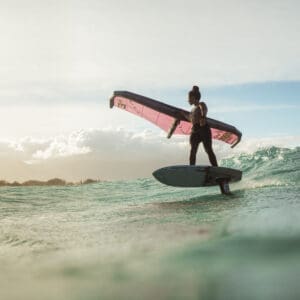
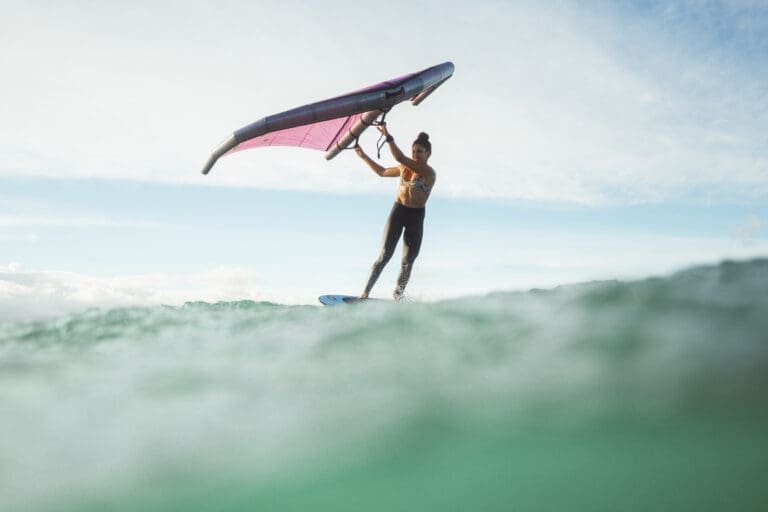
WIngfoiling provides the easiest and most immediate access to flying time, which is the single most important factor in learning. The wing offers superior control over speed and power and creates a safer environment for mastering the basics, like how to fall and recover.
This accessibility is critical for the health of the sport. Gabi notes that without a clear and forgiving entry point, only the most elite and dedicated athletes would ever get on foil, causing the sport’s growth to stall. Wing foiling opens the door for everyone else.
“Wing foiling is the best gateway into foiling in general.”
In Gabi’s philosophy, the single most important metric for improvement is time spent actively flying. She sees “time on foil” as the real currency of progression. This is where wing foiling’s versatility becomes its greatest strength.
Compared to the strict logistical demands of downwinding or the wave-dependency of prone foiling, winging is the most “forgiving, flexible discipline.” It allows a rider to get on the water and fly in a much wider range of conditions. This flexibility ensures she spends her time progressing by flying, not wasting it by slogging—the frustrating, low-speed struggle that kills a session.
For this reason, winging often becomes her default session when conditions are anything less than perfect.
“A lot of times that, like, I don’t know what I’m doing that day, it’ll end up being a wing day.”
But maximizing that ‘time on foil’ isn’t just about quantity; it’s also about quality. That’s why Gabi’s next rule transforms her wing from a simple tool into a high-tech laboratory.
One of Gabi’s most strategic practices is using wing foiling as her “primary testing platform” for all new equipment. Gabi is a team rider not only for Five-O but also Axis and Kalama so she is always part of product development and testing.
Before trusting a new foil or board in a critical environment like downwinding—where you have to “do the work to get up” and failure can mean a long swim—she first puts it through its paces under the controlled power of a wing.
She dedicates “20 minutes to an hour on the foil winging” to analyze key performance variables in this low-risk environment:
• Optimal foot placement and mast position.
• How quickly the foil generates lift.
• How the foil glides, carves, and recovers from breaches.
This process functions like a pilot using a flight simulator before flying a new jet. It allows her to learn the handling quirks of new gear in a safe setting, ensuring there are “no surprises” when the conditions are critical and performance is non-negotiable.
Navigating airline baggage limits is the bane of any traveling athlete, but Gabi streamlines her gear with a “crossover quiver strategy.” Rather than packing a board for every potential discipline, she makes one board do the work of two.
Specifically, she uses her primary Kalama Performance prone board, which measures approximately 4’4″ and 35L, as her wing board by simply adding straps. This “one board, two disciplines” approach is a masterclass in efficiency. For most riders this may be a larger board but the principle remains the same.
Think of it like packing a reversible jacket for a holiday: one high-quality item adapts to multiple situations, saving precious space for a specialist piece of gear, like a longer downwind board.
This isn’t just a pro-level hack; Gabi identifies it as an ideal strategy for intermediate riders who want to maximize their water time on a trip without “travelling with a full garage” of equipment.
For intermediate riders feeling stuck, Gabi’s advice is to simplify. A common mistake is trying to fix everything at once—working on multiple items of progression all in a single outing.
This scattered approach leaves you feeling and looking like you are just “surviving” on the water rather than riding with intent.
Her rule is simple: pick one focus per session. Keep every other aspect of your ride easy and controlled while you dedicate your mental energy to that single maneuver. True progression follows a clear path:
1. Master the Fundamentals: Before you even think about complex tricks, establish “solid straight-line riding” and confident falling. You should feel like you can ride almost with your eyes closed.
2. Own Your Course: Next, master reliable upwind and downwind control. Staying upwind is non-negotiable for a good session, but Gabi also notes that learning to turn slightly downwind is a key skill, as it reduces pressure and mimics the feeling of free-riding on a wave.
3. Make the Wing Disappear: Once you move into wave riding, the ultimate goal is to let the wave’s energy take over. Gabi aims to ignore the wing by keeping it “light and calm,” tucking it behind her body so the wind holds it up and it doesn’t limit her turns.
By isolating skills and mastering them in sequence, you build true competence instead of reinforcing bad habits.
Conclusion
In Gabi’s program, wing foiling is far more than a casual alternative. It’s the foundational practice that enables her ambitions in every other discipline. Think of it like a world-class musician practicing scales.
While the concert solo—the Sup DOwnwind channel crossing or critical prone foil wave—is the performance everyone applauds, the scales are where the real work is done. It’s in the repetitive, controlled environment of wing foiling that the muscle memory is built, the instrument is tuned, and the foundation for virtuosity is laid.
So, what are the “scales” in your own practice—the fundamental work that could unlock your next great performance?